
Five Fail-Safe Layers of Protection Against Drowning
Adult supervision, locked doors, perimeter door alarms, the pool fence, and swimming lessons. All five must fail before your child can drown in your pool.
Boo Boo Busters has researched all of the major pool fencing companies in Southern California. As with all our child safety devices, we have unearthed the best product and service providers for Orange and Los Angeles Counties.
Call (800) 940-1977 or email us at info@1252074.us17.myftpupload.com today to get more info on setting up a FREE pool fencing estimate. Please give us your name, contact info, and where you live. We will connect you with our pool fencing specialist.
Did You Know?
Drowning is the leading cause of accidental death for children under the age of five in California. For every drowning, there are eleven near drownings, many of which result in irreversible brain damage.
With children in the home and a swimming pool in the backyard, supervision becomes very important. But supervision, in itself, is not nearly enough.
Studies sponsored by the Customer Product Safety Commission report that nearly 69% of all swimming pool accidents took place when both parents were at home; 10% were being supervised by grandparents or other adults, and 7% by a sibling. 77% of the children had been seen five minutes or less before being missed and discovered in the pool, and many were thought to be taking a nap.
Layers of Protection
The following list is provided as a guide for parents and grandparents of children under 5 years of age with a swimming pool in the yard:
1. DOORS AND GATES leading to the pool area should be self-closing, locked, and alarmed.
2. Install a MOTION ALARM in the pool and spa area.
3. Install a CHILD-SAFE BARRIER (FENCE) around the immediate pool area and/or an approved pool cover. If you don’t block off every access, the child will eventually find a way to get to the pool when you are not looking. Do not deceive yourself by thinking. “My child would never try that”. Children are very smart, and you must assume that a child will find a way to beat the system. If you do not, you are asking for trouble.
4. Consider using a surface tension alarm.
5. When having a party, appoint a “DESIGNATED CHILD WATCHER” to constantly observe the children. Adults become preoccupied when socializing. They often assume someone else is watching the kids.
6. Do not consider children “water safe” just because they have had swimming lessons. THERE ARE NO WATER-SAFE CHILDREN. Kids lack the maturity level for sound judgment. Fun is their motivation, and a pool is fun; unfortunately, it is also dangerous.
7. NO ONE SHOULD EVER SWIM ALONE. Teach your children to use the buddy system. Since children learn by example, parents should follow these safety tips as well.
8. TOYS AND GAMES should not be stored in or near the pool. The attraction of toys near the pool is much too inviting for children.
9. NEVER LEAVE CHILDREN UNATTENDED for any reason. Keep a cell phone near the pool at all times. A large percentage of child drownings occur when the children are left unattended while the caretaker answers the telephone, the front door or while using the restroom.
10. If a child is missing, always check the pool first! TIME IS CRITICAL; if the child has “Silently” entered the water and is submerged, you have precious little time to react.
11. LEARN CPR. Anyone responsible for children, including grandparents, siblings, and babysitters, should know CPR. Post CPR instructions near the pool. Contact your local Red Cross for training information.
COMMON SENSE is the key to pool safety. There is no substitute for adult supervision. The National Spa and Pool Institute, the U.S. Consumer Product Safety Commission, and the American Academy of Pediatrics, all recommend AT LEAST A 60-INCH-HIGH BARRIER (FENCE) AROUND THE POOL!
Important Questions
Safety fencing has proven, over the past thirty years, to be the most practical and effective barrier against pool drowning.
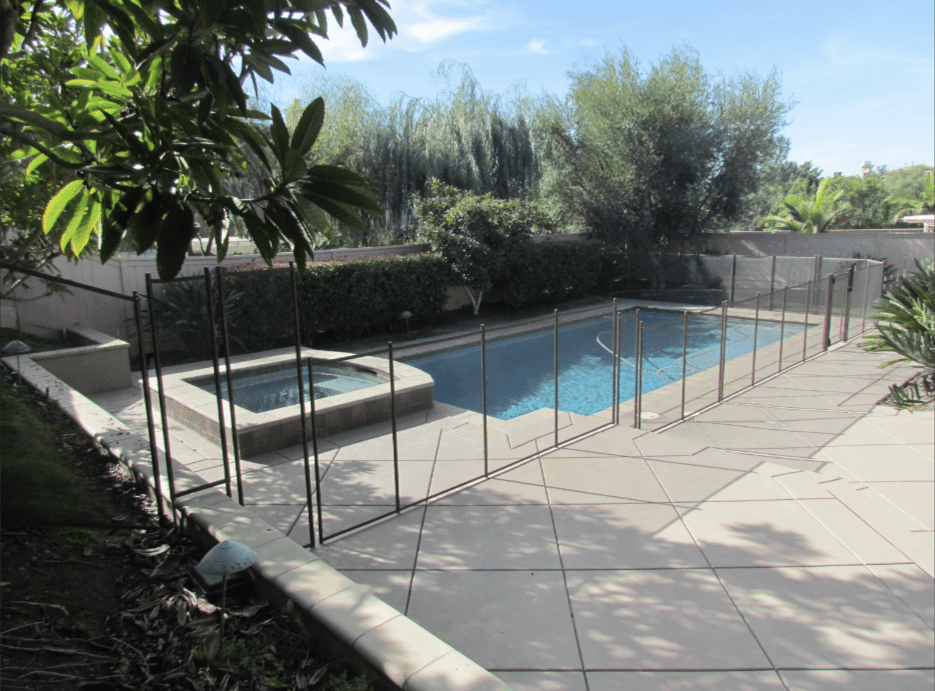
The concept is simple. Isolate the pool from your home and eliminate all access to the water by a toddler. For the pool to be truly isolated and the barriers to serve effectively, there must not be a reason to open the pool fence other than to use or service the pool itself. That means not having to open the pool fence to go out a screen enclosure door or into your backyard. These areas should be accessible to you without opening the swimming pool fence. The more times a fence is opened for a reason other than to use the pool, the greater the possibility that it will be left open for whatever reason. Children learn quickly to operate door locks and open doors that have not been locked. Your last layer of protection for the pool should be your pool fence.
The basic principle that keeps a pool fence in place is bilateral tension, and the fence should be checked periodically to ensure that you have the benefit of its full function.
A standard pool fence is removable in approximately twelve-foot sections. Each section can easily be rolled up and weighs only eleven pounds. The average one hundred-foot fence can be removed in less than fifteen minutes and be put back up in approximately the same amount of time. Most fences, however, are never taken down until children in the home are old enough not to require this safeguard any longer.
Think twice about removing the fence. Family gatherings and social affairs contribute to distraction and drowning accidents involving young children. So that the pool fence does not have to be removed for day-to-day use of the pool, a “gate” section is provided at the steps or another convenient location. A pool fence “gate” is formed by two connecting sections that can be opened by an adult. Extra sleeves are placed into the deck at this point to act as pole holders when the “gate” is open.
Self-closing, self-latching gates are automatic and provide better protection if there are folks in the house that can’t remember to close a gate behind them. Because it does not have to be physically closed or locked by the user, it is a more practical option when there are older children in the home who have unsupervised access to the swimming pool. A self-closing gate and its lock are mechanical devices located outside and subject to corrosion, wear from use, misalignment, and mechanical failure. Extra care must be taken to ensure that the gate is functioning properly. Be sure that your gate is always installed to swing out or away from the pool or water.
Pool fences range from 3 1/2 feet to 5 feet high. For an average toddler, we recommend you look at the 4-foot height. A child capable of climbing a 4-foot-high fence will most likely also be able to go over 5 feet. It’s just a longer fall down the other side. A child with this kind of capability should already be well into a swimming program.
We talk to parents moving into a home with a pool for the first time who are nervous about a six-year-old around the pool accidentally falling in. Since a six year-old can go over any height fence and the fence is being installed to basically keep them from just falling into the pool by accident, we would recommend a shorter height like 3 1/2 feet as long as this is the only child in the household.
Call (800) 940-1977 or click here to email us about pool fencing. Please give us your name, contact info, and where you live. We will connect you with our pool fencing specialist.