
Boo Boo Busters

Safety Info

Boo Boo Busters loves to educate new parents about injury prevention. Feel free to reprint any of the below information at no cost to aid in our education efforts. If you live in the L.A. or O.C. areas, we’d very much appreciate a story credit.

Baby Proofing 101 – How to Create a Baby-Safe Home Environme

Your home will undergo some changes even before the birth of your newborn. But fear not! Child safety devices have come a long way in recent years, with more product choices for aesthetic and consumer-minded parents. Safety comes first, but babyproofing doesn’t have to look unattractive or be inconvenient. We have assessed countless injury-prevention devices to uncover my favorite “Mommy Tested & Approved” products that save new parents time and frustration.

Babyproof Before Your Baby Starts Crawling

The average baby begins to crawl at about six months, when parenting becomes both exciting and terrifying. Some infants roll before they sit up and can surprisingly make their way across the room! With curiosity but no common sense yet, babies constantly propel themselves into harm’s way.

Some parents babyproof while still pregnant, which is ideal and highly recommended. Others postpone and find themselves panicked once their baby becomes mobile. Parenthood is demanding, and time passes quickly. Be proactive—babyproof before your baby starts crawling.

A Powerful One-Two Combo: Babyproofing and Discipline

More than *four million children end up in the emergency room each year as a result of accidents, but *90% could have been avoided (*SafeKids.org). While nothing replaces vigilant supervision, proactive childproofing prevents needless injury.

Even before your baby explores on his own, begin teaching what’s safe and what’s not. For example, the stove, trash can, toilet, and doggy door are “no-no’s” that cause “boo-boos.” Use consistent language across caregivers. Babyproofing and discipline overlap, and it’s never too early to start.

Lengthen the Life of Your Babyproofing

Given time, some children can outsmart safety devices. They’ve been watching your every move, and once their motor skills catch up, they may figure things out quickly.

For example, babies who are walking can open levered door handles. (Top door locks are effective for these when knob covers don’t fit.) To prolong device effectiveness, operate locks with your back to your child. Safety devices are there to slow your child until you can intervene with a loving but firm, “No, no. Not for babies.” After one warning, remove your child from the restricted area. Yes, you’ll repeat this hundreds of times, but it’s part of parenthood.

Have Off-Limits Rooms

The cheapest and quickest way to babyproof is to limit access. Make certain rooms off-limits using door locks: guest room, garage, laundry room, loft, terrace, older sibling’s room, office, gym, utility room, craft room, or rooms under construction.

Children who learn boundaries early behave better when visiting other homes or stores. No unsupervised bathroom access until potty training is complete. Install locks on bathrooms, toilets, and cabinets to stop curious babies from wandering into danger.

Install flip locks high on front doors and doors leading outside or into the garage. These locks prevent children from going outdoors or answering the door unsupervised.

Common Hazards in Every Home

Some dangers are obvious; others less so. While hundreds of household hazards exist, many can be easily addressed once identified. Some homes require custom solutions or temporary removal of certain items until children are older.

A professional opinion can provide peace of mind, ensuring nothing is overlooked. Below is a list of recommended childproofing tips for every home, broken down by hazard type.

Home Safety Checklist

Electrical

  • Replace all outlet covers with sliding outlet covers. Use box outlet covers for oversized plugs in outlets.
  • NOTE: Commonly known plastic push plugs should not be used in outlets, as they are now considered choking hazards. FYI, anything that can fit inside an empty toilet paper roll is considered a choking hazard.
  • Use cord control kits to organize and house all wires. Make offices an off-limits area. Cover exposed frayed wires.
  • Use power strip covers to secure strips with multiple plugs.
  • GFCI outlets should be in all areas that come in contact with water.

Tipping

  • Anchor all armoires, shelving units, dressers, etc., or appliances (T.V’s) that can topple onto a child as a result of climbing or pulling. When drawers are open simultaneously, the unit, however sturdy, becomes front-heavy and tips easily on its own or with the weight of a toddler pushing on an open drawer. Little ones do this trick to climb the dresser to get what’s on top of it.
  • Many children have lost their lives or been injured due to unanchored Television sets.
  • Earthquake securing is equally important.

Falls

  • Install window guards with emergency release latches on all windows on the second level or higher. Screens are not babyproofing devices.
  • Beware of toy stacking. Children will pile up anything to get a view outside. Move furniture away from half walls where a child can climb up and fall over. Consider having Plexiglass installed to extend dangerous pony (or half) walls.
  • Mount safety gate at stair top and bottom. Professional babyproofers offer top-quality gates, extensions, and custom mount kits for wood and wrought iron banisters. Pressure gates are not recommended for stairs or high traffic areas – use mounted ones instead.
  • If banister posts have a gap 4 inches or more apart, install a Plexiglass.
  • Install custom-cut Plexiglass on stair banisters and decks that are not up to code or if there are decorative embellishments on wrought iron rail or banister that will serve as a foothold or ladder for a climbing child.
  • Never let a child play unattended on a loft or balcony. Remove tables, chairs, and other objects your child can climb onto from the balcony deck to prevent falls over the railing.
  • Be sure all area rugs and mats have non-skid bottoms to avoid slipping.
  • Never leave an infant unattended on a changing table or bed. Always keep one hand on the child at all times.
  • Never let a child play on stairs unattended.

Chemical

  • Move all chemicals (including cleaning supplies, various beauty and childcare accessories, alcohol, etc.) to a high, locked cabinet.
  • Install child safety locks on all accessible cabinets that contain these toxic items. These are much more reliable than latches and are impossible to open without a magnetic lock key.
  • No unsupervised entry into the garage and laundry room.
  • CO detectors should be installed on each level of the home near sleeping quarters.
  • Do not use sunscreen on babies under six months of age.

Plants

Find out which plants in your home and yard are poisonous. In California, landscapers commonly use oleander, which is highly toxic. If there is a plant in question, cut off a sprig, put it in a Ziploc bag, and bring it to a local plant nursery for their input.

Pets

  • Keep all pet doors closed off when the child is present – disengage automatic/sensory pet doors.
  • Pets can run through the door and knock over the child, and/or the child can escape to the outside via the door, which is at their eye level and quite inviting to little ones.
  • Never allow your child access to an animal you don’t already know is good with children. Don’t allow the child to hug the dog or kiss the pet's face.
  • Don’t bring small children to dog parks or go if you’re pregnant. A staff member was broadsided by two dogs at a dog park when she was seven months pregnant and broke her leg. She was able to try out the epidural 3 months before she actually delivered her first child, so her orthopedic surgeon could screw her leg together. Freak accident, maybe, but not worth risking the life of your unborn child.
  • Do not allow cats into the nursery, as they can smother an infant. Use a crib tent on the crib or pack and play if you have cats.

Choking/Strangulation

  • Anything that will fit inside an empty cardboard toilet paper roll can be considered a choking hazard.
  • Replace all old doorstops that have removable rubber tips with one-piece doorstops, as the small rubber tip is a choking hazard.
  • Remove bolt covers on toilets as they are hidden choking hazards.
  • Do a visual safety sweep of the home every day before the child wakes to make sure all small objects are picked up/swept off the floor.
  • Beware of older children’s toys that can be choking hazards. Use locked storage bins for small pieces. Limit play with these toys until the baby is napping. Disallow Magnetix-type toys, as an ingested magnet can cause lethal intestinal complications.
  • Install blind cord cleats and wrap all dangling blind cords to disallow strangulation.
  • Clean under furniture cushions daily, as items easily fall from pockets and out of sight.
  • Remove toy mobiles and canopies from the crib once the child is sitting up.
  • Keep baby monitor or any other plugged-in device away from the child’s reach.
  • Be watchful.

Water

  • Never leave the child unattended in or around water.
  • Avoid the most common drowning hazard and have a pool fence, cover, or net installed over all pools and spas. House alarms – the ones that beep every time someone opens a door or window in your home — are great safety measures.
  • When swimming with a baby or small child, always keep them within arm’s distance and PAY ATTENTION. Being engrossed in a conversation with someone while “watching your child” is very dangerous.
  • Babies can fall into toilets headfirst and not be able to get out, so be sure to install toilet locks as well as keep bathrooms locked and off-limits.
  • After it rains, do a visual safety sweep of the yard to look for planters, buckets, or water tables with pooled water and dump it out.
  • Turn your water heater down to 120 degrees Fahrenheit to avoid the risk of scalding.

Humans

  • Use back burners in the kitchen and turn pot handles in.
  • Parents make a habit of holding the handrail when using stairs when carrying a child.
  • Keep doors to “off-limits” rooms pulled closed. The lock only works if the door is kept closed.
  • Beware of elderly or older children with non-safe household habits. They will unintentionally leave medicines out, drop pills, leave doors/cabinets/drawers open, etc. You can educate your family members to be mindful of their unsafe habits, but at the end of the day, the baby’s safety is your responsibility.
  • Beware of small siblings picking up the baby.
  • Be vigilant about supervising your child. You can babyproof your home like a safety fortress, but there is no replacement for your constant attention to your child and detail.
  • Turn off the TV if you are not watching it with your child. The program may be child-safe, but the commercials might not. There are some pretty terrifying things on TV that will not physically harm a baby but can cause damage. See your pediatrician about this topic for more information.

A Virtual Home Safety Evaluation

The following is a room-by-room walkthrough of an average family home. Keep in mind that most homes were not designed with the safety of a baby or child in mind. Each residence has special features that are unique as well as common safety challenges. Below is a list of solutions to common safety hazards found in most homes:
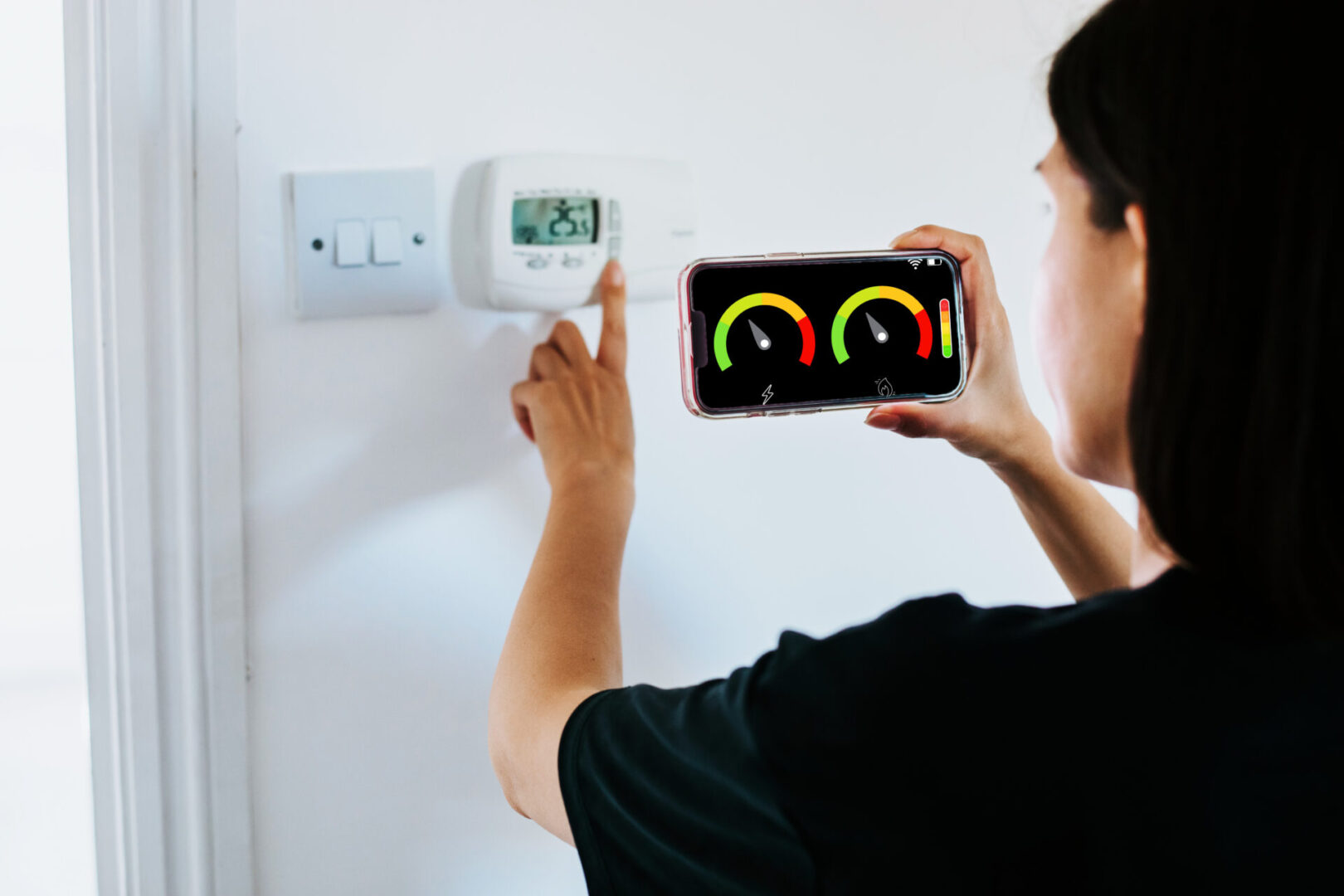
Person adjusting thermostat with smartphone app.

Kitchen

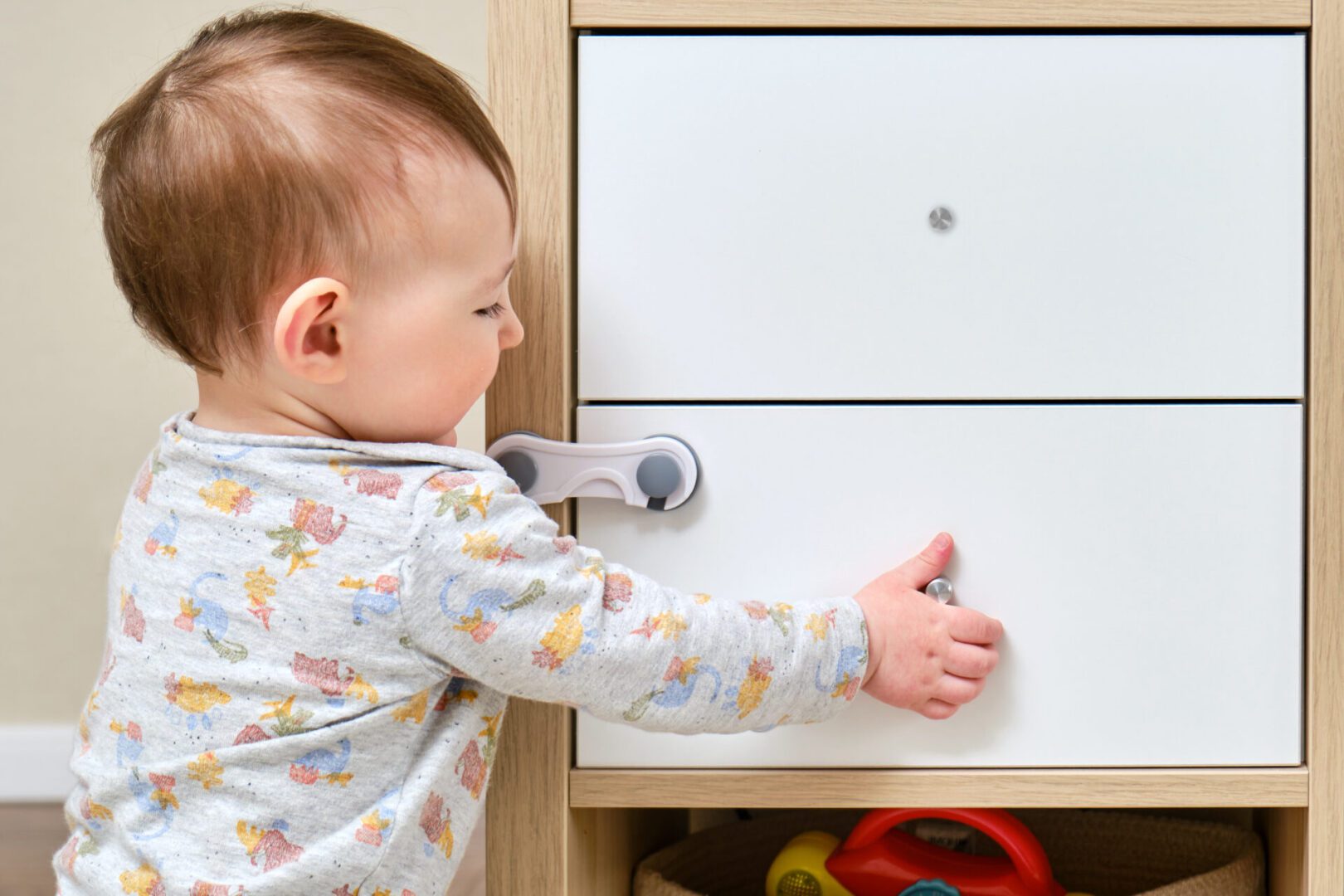
  • Install child safety locks on all accessible drawers and cabinets that contain toxic items (i.e., cleaning supplies, alcohol, vitamins, plastic bags, etc.)
  • Gate off the kitchen area.
  • Keep the child in a high chair or pack and play during meal preparation.
  • Latch all other drawers and cabinets. We recommend babyproofing for safety first and foremost; however, it’s also a matter of convenience. If you choose, keep one cupboard with Tupperware lids unlocked for the child to access, but be sure they cannot use this open cabinet or drawer as a step to climb up onto the counter. Your child may not be able to reach certain drawers now, but he surely will in no time.
  • Never let a child play with pots or pans, as it sends the wrong message to the child that these are toys. When a child sees the same pots/pans on the stovetop, he will want to grab his familiar “toy.”
  • Consider latching all appliances a child can access, like the refrigerator, dishwasher, trash compactor, dumbwaiter, and oven.
  • Keep all appliances on the counter unplugged and hide electrical cords.
  • Do not hang dish towels on the oven door, as the baby can pull the towel and bring the door down into the bridge of his nose.
  • Use back burners on the stove and install stove guards and knob covers if the child has access to them.
  • Do not use small or breakable refrigerator magnets, as they are choking hazards.
  • Beware of leaving knives, scissors, coffee mugs, etc. out on the counter, as the child will grab at whatever they can get a handle on from their vantage.

Bathrooms

  • No unsupervised entry into the bathroom.
  • Use safety locks on the door at all times.
  • Install toilet locks to prevent children from drowning and throwing objects in.
  • Latch all cabinets.
  • Move the wastebasket under the sink behind a latched cabinet door or use a covered receptacle.
  • Turn water heater down to 120 degrees to prevent scalding.
  • Always check the water temperature on your inner wrist prior to putting the baby into it.
  • Never leave a child in the bath unattended.
  • Never leave a filled tub unattended, and drain the tub immediately after use. Children can wander in and drown.
  • Use a no-slip mat to prevent slipping and a spout cover to prevent scalding and cuts.
  • Remove all electrical appliances from the bathroom where the child bathes.

Living Room/Family Room

  • Eliminate baby’s access to fireplaces, wood stoves, and hot tubs using gates developed for this purpose. If gates will not work on the fireplace, use specially designed fireplace locks on glass accordion doors and install hearth padding around the edges of the hearth to prevent the child from falling onto it.
  • Remove the gas key from the fireplace gas gauge and store it in a high place.
  • Anchor all items that are tipping hazards.
  • Anchor TVs.
  • Remove all items (torchiere lamps, freestanding coat racks, statues, etc.) from the home until the child is older.
  • Cover end tables, coffee tables, countertops, and low dressers' furniture corners and edges with cushioning created for this purpose.

Decks

  • No unsupervised access to decks. Beware of your child stacking toys/objects to see over the railing.
  • Install a Plexiglass or net barrier if there is more than 2 ½ inches between railing posts.
  • Put decals on sliding glass doors at baby’s eye level so he or she doesn’t run into them.
  • Always keep the baby away from the grill. Hearth gates work well for this purpose.
  • Do not use deck furniture to eliminate the risk of climbing.
  • Always lock all doors leading to decks.

Nursery

  • The U.S. Consumer Product Safety Commission, National Safety Council, and the American Academy of Pediatrics have the following helpful safety suggestions for your child’s nursery.
  • ALWAYS place your baby to sleep on his or her back. This greatly reduces the risk from SIDS (Sudden Infant Death Syndrome) or suffocation. Since the American Academy of Pediatrics recommended back-sleeping five years ago, SIDS deaths in the USA have declined by 38%.
  • Remove all soft bedding-pillows, comforters, blankets, and stuffed animals-from the crib to further reduce the risk of suffocation. Instead of a blanket, dress baby in a sleep sack or sleeper.
  • Make sure the crib itself meets current safety standards. This means:
  • The slats are no more than 2 3/8″ apart.
  • The mattress is firm, not soft (foam or coil – your preference)
  • Corner posts are level with the height of the end panels (just 1/16″ higher at most)
  • There are no decorative cut-outs in the headboard or footboard.
  • Top rails, when raised, are at least 26″ above the mattress support in its lowest position.
  • Hardware is secure-no loose or broken screws or pieces. Recheck periodically.
  • Drop sides cannot be accidentally released by a child. (According to the National Safety Council, the crib sides should require two separate steps to release. If this is a one-step process, it should require a minimum force of 10 pounds to release.)
  • Look for a JPMA safety certification seal on newly manufactured cribs.
  • Top rails should be covered by teething guards.
  • Keep blind cords, curtain pulls, décor, electrical cords, and mobiles out of baby’s reach.
  • Maintain a cool room temperature; give a recommended range to prevent overheating.
  • Place baby’s crib away from any source of draft.
  • Make sure baby’s fitted sheet is secured to the mattress and will not pop loose.
  • Place a baby monitor in the nursery, far from the child’s reach.
  • Consider purchasing a special crib mattress that circulates air around the baby. This helps prevent the “rebreathing” of carbon dioxide, which is believed to be a leading cause of SIDS.
  • If you use bumper pads, make sure they are tightly secured to the sides of the cribs. Trim excess ties or straps. Straps should be loose, easy to push down to the mattress, and not hung up on any hardware. You don’t want your child to get a foothold on the bumper to be able to climb out.
  • When the child is sitting up, remove bumper pads and all other animals or pillows and lower the crib mattress to the lowest position.
  • Once the top of the crib rails are less than three-fourths your child’s height or they are 36 inches tall, it’s time to move to a toddler bed.
  • If you have a child who climbs out of the crib before the above point, seriously consider using a crib tent. Some parents don’t like it, but the potential alternatives are far worse.
  • Install finger guards or a door mouse on fast-closing doors.
  • Anchor all furniture, cover all outlets (even ones behind the crib), and install locks or window guards on all windows.
  • Use earthquake putty on all objects placed on shelving. Use Velcro to secure the base of pictures on walls – stick to wall and the back of the frame, and it will prevent it from falling and breaking during a quake.
  • Use locks (suction cups are best) on sliding closet doors until the baby can open and close them without pinching fingers or slamming, causing glass doors to crack.
  • Pick up the room every night before bed so in the event of an emergency you can get to your child quickly without incident.
  • When a child is in a toddler bed, use a pressure gate in the doorway to prevent the child from walking around the house unsupervised during the night. Instruct the child to call for you when he is awake in the morning.

Fire & Health Safety

  • Store fire escape ladders in every bedroom on the second level and above.
  • Place working fire alarms in every bedroom and on every story, and remember to check them regularly. Daylight saving time is a good marker to use to check your alarms bi-annually.
  • Make sure all fire/smoke alarms are in working order. The vocal smoke alarms will record Mom's or Dad's voice so the child will hear detailed instruction from parents as to what to do in the event of a fire.
  • Install carbon monoxide detectors on each level of the home near sleeping areas.
  • Install natural gas detectors on each level of the home near sleeping areas.
  • Create and practice a disaster plan. (i.e., fire escape plan, earthquake plan, disaster plan.)
  • Purchase disaster preparedness kits.
  • Place fire safety decals (KidsInHere™) on the bottom outside of the child’s room door(s) and outside window(s) (exercise discretion here), and in the event of a fire, these reflective stickers will alert firefighters to search for the child/children.
  • Place the phone number of the poison control center near the telephone. You will need to know your child’s weight to treat a poisoning. Never use ipecac unless instructed by a professional to do so.
  • Learn first aid and CPR and keep your skills up-to-date.
  • All guns are to be locked up with the key in a safe and separate place.